





Listed in Road Maintenance
How to Estimate Hot Mix Asphalt for Road Paving
For Highway Superintendents
 Shortcut to our hot mix calculator
Accurately estimating how much hot mix asphalt (HMA) you’ll need to pave a section of road is key to staying on budget, reducing waste, and keeping your crew productive. Fortunately, the math is straightforward, and once you’ve got a system, it becomes second nature. Here’s how to do it step-by-step.
1. Measure the Area to Be Paved
You’ll need to know:
-
Length of the road segment (in feet)
-
Width of the paved surface (in feet)
-
Thickness of the compacted asphalt layer (in inches)
Let’s say:
-
Length = 1,000 feet
-
Width = 24 feet (a typical two-lane road)
-
Thickness = 2 inches
2. Convert to Cubic Feet
First, calculate the volume in cubic feet:
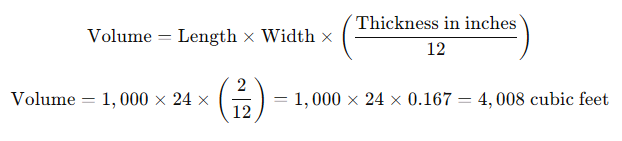
3. Convert Cubic Feet to Tons of Asphalt
Hot mix asphalt typically weighs about 145 pounds per cubic foot, or 3,915 pounds per cubic yard. One ton equals 2,000 pounds.
To convert from cubic feet to tons:

4. Round Up and Add a Buffer
You’ll want to round up to the nearest whole number and add 5–10% extra to account for variable compaction, surface irregularities, and loading/hauling inefficiencies.
-
290.58 tons rounded up = 291 tons
-
10% buffer = ~29 tons
-
Order Total = 320 tons
5. Use an Asphalt Calculator Tool (Optional)
There are many free online tools that let you plug in your measurements and get an instant estimate. These can save time and help you double-check your math. But understanding the process helps you spot problems before they happen.
Quick Reference Table (Per 1,000 ft of Road)
| Width (ft) | 2” Thick (tons) | 3” Thick (tons) |
|---|---|---|
| 20 | 242 | 363 |
| 22 | 266 | 399 |
| 24 | 290 | 435 |
| 26 | 314 | 471 |
| 28 | 339 | 508 |
Includes only the compacted volume. Always add a buffer when ordering.
-
Always use compacted thickness when estimating.
-
For overlays, consider milling depth and transitions.
-
Double-check your scale tickets during delivery.
-
For small jobs, coordinate with the supplier about partial loads or reheat risk.
Simple Forumulas
Tons = (Length × Width × Thickness × 0.0031)
What the numbers mean:
-
Length = length of the road in feet
-
Width = width of the paved area in feet
-
Thickness = depth of compacted asphalt in inches
-
0.0031 = a constant that converts cubic feet and asphalt density to tons
✅ Example:
You're paving 1,000 feet of 24-foot-wide road at 2 inches thick:
Tons=1,000×24×2×0.0031=148.8 tons\text{Tons} = 1,000 \times 24 \times 2 \times 0.0031 = 148.8 \text{ tons}Tons=1,000×24×2×0.0031=148.8 tons
Add 5–10% for waste and variations:
-
Final order: ~160–165 tons
Why This Formula Works:
It wraps up all the conversions (inches to feet, cubic feet to pounds, pounds to tons) and assumes a typical hot mix density of about 145 pounds per cubic foot.
✅ Better Formula (Accurate and Simple)
Tons = (Length × Width × Thickness in inches × 0.0031)
This uses:
-
Asphalt at ~145 lb/ft3
-
All conversions built in
-
Matches actual plant ticket tonnage much more closely
By following these steps, you can confidently estimate how much hot mix asphalt your project will require, and avoid the cost and hassle of under- or over-ordering.