





Listed in Road Maintenance
The story of the American roadway is closely tied to settlement, commerce, and national growth. Long before asphalt and concrete shaped the landscape, early paths followed the natural contours of the land. Over centuries, these informal routes evolved into engineered transportation corridors designed to move people, goods, and services efficiently across vast distances.
Long before European settlement, Indigenous peoples created extensive networks of footpaths across North America. These trails connected villages, hunting grounds, and trading partners, often following ridgelines, riverbanks, and natural passes. The routes were practical rather than engineered, chosen to avoid wetlands, steep grades, and dense vegetation. Many modern roads and highways still follow alignments that originated as Native American trails, particularly in the eastern United States.
As European settlers arrived, these trails became the foundation for early colonial roads. Wagons, livestock, and postal riders required wider paths, but construction methods remained basic. Trees were cleared, stumps were cut flush with the ground, and soil was compacted by repeated use rather than design. These roads were often muddy in spring, dusty in summer, and nearly impassable in winter. Maintenance was typically handled by local landowners under colonial laws requiring road labor instead of taxes.
Roman Chariot Gauge Myth
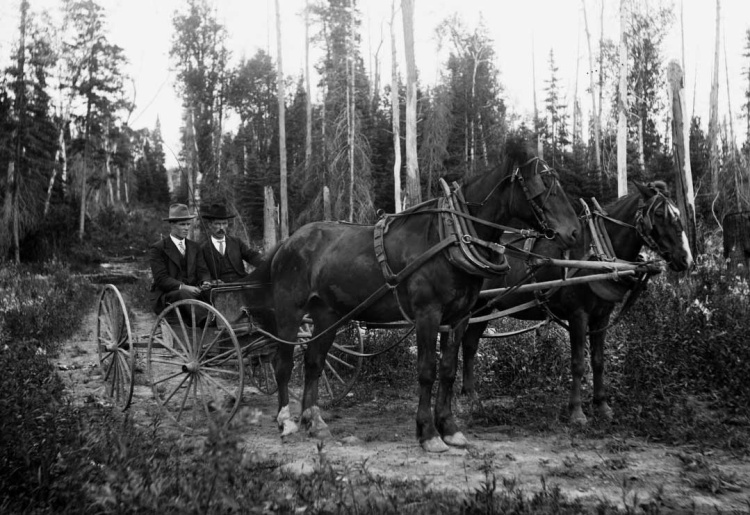
You may have read or heard on TV - or on a YouTube video - that the width of modern roads is based on the width of two horses, harnessed side-by-side, pulling a Roman chariot. In academic and engineering history circles, it is usually discussed as an infrastructure origin myth. That term is used for stories that attempt to explain modern standards by tracing them back to a single ancient cause. In this case, the claim is that Roman chariot wheel spacing determined wagon widths, which determined railroad gauge, which then constrained everything from tunnels to highways. The narrative is tidy, memorable, and mostly wrong.
The myth gained modern popularity in the twentieth century, especially after a widely circulated explanation attributed to engineers at NASA in the 1970s and 1980s. That version humorously claimed that even the Space Shuttle was indirectly sized by the width of two Roman horses. While entertaining, historians and transportation engineers have repeatedly pointed out that it ignores centuries of regional variation, economic decisions, and independent engineering choices.
When the topic appears in serious historical writing, authors typically describe it as a folk explanation or urban legend of engineering history, rather than a documented lineage. Roman vehicles did influence some local road wear patterns within the territory of the Roman Empire, but there is no continuous, enforced dimensional standard linking Roman chariots to modern roads or railways.
So while people may casually call it “the Roman chariot myth,” the more accurate classification is that it is a persistent infrastructure myth, appealing because it suggests that ancient decisions still quietly control the modern world.
Roman roads were carefully engineered by the standards of their time, with stone foundations, drainage, and durable surfaces. Archaeological evidence shows that many Roman roads developed wheel ruts over centuries of use. These ruts often appear at fairly consistent spacings, largely because carts and wagons tended to be built to similar proportions. That consistency was practical rather than mandated. Vehicle widths were influenced by animal size, balance, and the need to fit through city gates and along narrow streets, not by a universal Roman standard enforced across the empire of the Roman Empire.
The popular version of the story often jumps from Roman chariots directly to modern highways or railroads. That leap is where the myth stretches too far. While it is true that later European wagons tended to follow similar proportions, this continuity came from practicality and tradition rather than formal inheritance. Roads gradually adapted to the vehicles using them, and vehicles were built to suit existing roads. Over time, a rough equilibrium emerged.
The railroad connection is where the story becomes more interesting, but still not quite as tidy as folklore suggests. Early railways in England were built to carry coal wagons, and those wagons were sized to work with existing horse drawn carts. When railways expanded, engineers reused familiar dimensions. The standard railroad gauge of 4 feet 8½ inches was ultimately adopted because it worked well and because changing it would have been costly once infrastructure was in place. This gauge was popularized by George Stephenson, not because of Roman decree, but because it aligned with earlier wagonways and proved reliable.
As for modern roads, there is no fixed width inherited from Roman times. Road widths evolved with vehicle size, speed, safety considerations, and engineering standards. Early American roads, for example, varied widely in width depending on location and use. Modern lane widths are based on vehicle dynamics, safety margins, and traffic efficiency, not on the width of horses.
In short, the idea that “roads are the width of two horses because of the Romans” is a compelling story, but it compresses centuries of gradual, practical decision making into a single origin myth. The real history is less romantic but more interesting. Transportation infrastructure evolved through repeated cycles of vehicles adapting to roads and roads adapting to vehicles, shaped by convenience, economics, and engineering rather than a single ancient measurement.
Needs Evolve, Road Evolve
By the late eighteenth and early nineteenth centuries, growing commerce created demand for more reliable transportation. Turnpikes emerged as an early solution. These were privately operated toll roads built with improved grading, drainage, and gravel surfaces. Although still primitive by modern standards, turnpikes represented an important shift toward planned roadway construction. They supported stagecoaches, freight wagons, and regional trade, helping connect inland communities to ports and markets.
The Industrial Revolution and westward expansion accelerated roadway development. As railroads dominated long distance travel in the nineteenth century, many roads fell into poor condition. However, roads remained essential for local access, agriculture, and emerging industries. Toward the end of the century, bicyclists and early automobile enthusiasts began advocating for better roads, sparking what became known as the Good Roads Movement. This movement pushed governments to recognize roads as public infrastructure deserving of investment and engineering expertise.
The twentieth century marked a turning point in American roadway design. The rise of automobiles required smoother surfaces, gentler curves, and standardized construction practices. Engineers introduced layered road structures, with prepared subgrades, base courses, and durable surface materials like asphalt and concrete. Drainage systems became integral to roadway longevity, addressing one of the greatest weaknesses of earlier roads.
The most dramatic transformation came with the creation of the Interstate Highway System under the Federal Aid Highway Act of 1956, overseen by the Federal Highway Administration. This program introduced limited access highways designed for high speed, long distance travel. Interstates featured controlled entrances, grade separated interchanges, standardized signage, and rigorous engineering standards. They reshaped cities, fueled suburban growth, and revolutionized freight movement across the country.
Today, American roadways are complex engineered systems. Modern highways incorporate advanced materials, traffic modeling, safety features, and environmental considerations. Pavement designs are tailored to traffic loads and climate, while asset management systems track condition, maintenance history, and lifecycle costs. Roads now serve not only vehicles, but also pedestrians, cyclists, and transit systems, reflecting evolving transportation priorities.
From footpaths worn into the landscape to multilane highways spanning thousands of miles, American roads tell a story of adaptation and innovation. Each stage of their evolution reflects the needs, technologies, and values of the era that built them, forming the backbone of the nation’s transportation network and its economic growth.
