





Listed in Road Maintenance
How highway departments objectively measure roadway health, and turn numbers into smarter maintenance decisions
What the Pavement Condition Index (PCI) actually is
The Pavement Condition Index is a numerical score (0–100) that expresses the structural and functional health of an asphalt or concrete surface. It was formalized by the U.S. Army Corps of Engineers in the 1970s and is now codified in ASTM D6433. Because the method is standardized, a PCI of 72 in Vermont means the same thing as a 72 in Arizona, making it the language of choice for comparing roads, competing for grants, and prioritizing repairs.
-
100 - 86 = Excellent (maintenance optional)
-
85 - 71 = Good (routine preservation)
-
70 - 56 = Satisfactory (schedule preventive work)
-
55 - 41 = Fair (program rehabilitation)
-
40 - 26 = Poor (rehabilitation or reconstruction)
-
25 - 0 = Serious to Failed (full reconstruction often required)
From centerline to spreadsheet - how a PCI survey is organized
| Step | What happens | Key choices |
|---|---|---|
| Network definition | Compile every segment under your jurisdiction, including alleys and dead-ends, into an inventory. | Decide segment breaks (intersections, changes in width, surface type, or traffic volume). |
| Sample unit selection | ASTM recommends random, statistically valid sampling, typically 10 % of a segment’s area if budgets are tight. | Higher traffic or critical corridors can be 100 % inspected. |
| Field inspection | Inspectors walk or slowly drive each sample unit, recording each distress type, severity, and quantity on standard forms or tablets. | Pick a survey method: • Manual visual (clipboard or tablet) • Automated video & AI • Vehicle-mounted lasers & LiDAR |
| Data reduction & QA | Raw tallies are checked for outliers, unit conversions, and duplicate entries before calculation. | Software like Roadwurx allows you record the PCI for each road. |
| PCI calculation | For each sample unit, calculate Deduct Values (DVs) for every distress, apply the Corrected Deduct Value (CDV) curve, then: PCI=100 -CDVPCI = 100 - CDV | Weighted averages roll unit scores up to segments, then to your entire network. |
Inside the field book: rating distresses
ASTM D6433 lists 21 asphalt and 19 concrete distress types. Each is graded Low, Medium, or High severity. Examples for asphalt:
| Distress | Severity clues | Why it matters |
|---|---|---|
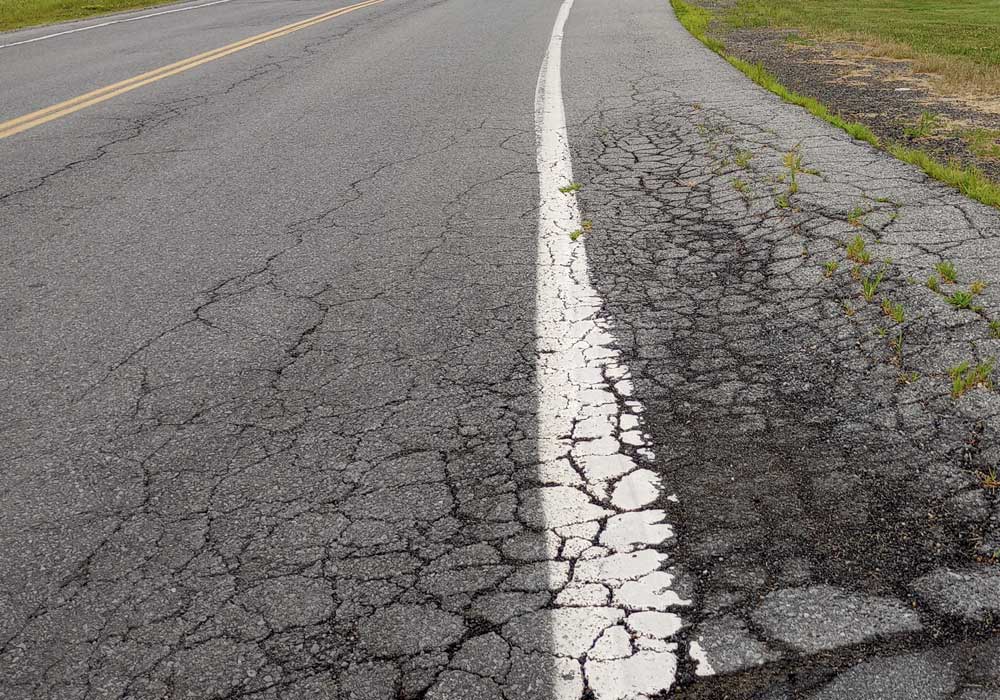
| Alligator cracking | <1 mm (L), 1-6 mm (M), >6 mm + pumping (H) | Signals structural failure of the base. |
| Block cracking | Squares >1.5 m (L) to missing pieces (H) | Caused by temperature cycling; loss of flexibility. |
| Raveling | Aggregate loss <12 mm depth (L) to exposed base (H) | Skid risk, accelerated oxidation. |
| Rutting | <10 mm (L) to >20 mm (H) | Hydroplaning hazard, foundation issues. |
Inspectors record the surface area or length affected in square meters or linear meters. Modern mobile apps let them tap distress icons and drag polygons on live video, reducing transcription errors and GIS-tagging the defect automatically.
Crunching the numbers: from distress tallies to a PCI score
-
Normalize quantities to a percentage of the sample unit’s area.
-
Look up each distress’s Maximum Deduct Value (MDV) in ASTM tables.
-
Compute DV = MDV × (quantity % / 100).
-
List all DVs in descending order and calculate the Corrected Deduct Value (CDV) using the standard curve (this prevents double-penalizing overlapping distresses).
-
PCI = 100 - CDV (rounded to the nearest whole number).
Quick illustration
A 250 m² sample unit has:
-
Alligator cracking, High, covering 12 % ⇒ DV = 37
-
Raveling, Medium, covering 6 % ⇒ DV = 9
-
Patch, Low, covering 4 % ⇒ DV = 5
Sorted DVs: 37, 9, 5 ⇒ CDV (from ASTM curve) ≈ 41
PCI = 100 - 41 = 59 (Fair)
Field tips for reliable PCI numbers
| Pitfall | Prevention |
|---|---|
| Subjective severity calls | Pair new staff with a PCI-certified mentor; use photo libraries for calibration. |
| Skipping pavements with utility cuts | Even a fresh patch may hide compaction issues, inspect them. |
| Inconsistent segment lengths | Lock in a master GIS layer and resist ad-hoc changes mid-survey. |
| Data lag | Choose software that syncs from the field (Roadwurx does it even without cell service; it uploads when a signal returns). |
How often should you resurvey?
| Road class | Recommended cycle |
|---|---|
| Interstates & arterials | 1-2 years |
| Collectors | 2-3 years |
| Local/low-volume | 3-5 years |
High-traffic snowbelt roads may justify annual PCI checks because freeze–thaw cycles accelerate distress.
Turning a score into action
-
Trigger thresholds – e.g., schedule crack sealing when PCI drops below 80, mill-and-overlay below 60, FDR below 45.
-
Deterioration curves – Model how fast a segment loses PCI; preventive work at PCI ≈ 70 can cost 4–6 × less than waiting for PCI ≈ 40.
-
Grant leverage – Many state DOT funds require documented need; a defensible PCI survey checks that box.
New frontiers: AI, LiDAR, and continuous monitoring
-
Machine-vision vans now collect 360° imagery at highway speed, while deep-learning models auto-classify distresses in hours, not weeks.
-
Mobile LiDAR captures rut depth and roughness simultaneously, feeding directly into PCI algorithms.
-
Drone orthomosaics let small towns map gravel-road washboarding without blocking traffic.
The ASTM method still governs the math, but these tools slash labor and improve repeatability—features already on Roadwurx’s integration roadmap.
A credible Pavement Condition Index survey is more than a once-and-done rating; it is a living baseline that guides every resurfacing dollar you spend. When you pair a rigorous PCI program with an asset-management platform like Roadwurx, you stop guessing, start forecasting, and ultimately stretch limited budgets across more lane-miles.