






Listed in Road Maintenance
If you’ve spent any time trying to assign a Pavement Condition Index (PCI) score, you’ve probably run into the same problem: the road isn’t uniform. Most of it looks good, but a short section might be failing badly. Suddenly, assigning a single number feels subjective and uncomfortable.
This is where many people get stuck.
The truth is that PCI was never meant to produce a perfect, universally “correct” number. It is a structured way to summarize pavement condition so you can make better maintenance and budgeting decisions. Once you understand that, the scoring process becomes much more manageable.
Start With the Right Mindset
Before getting into methods, it’s important to reset expectations.
A PCI score is:
- A summary, not a detailed diagnosis
- A decision-making tool, not a scientific constant
- Dependent on engineering judgment, not just math
Trying to make it perfectly precise often leads to overthinking. What matters most is that your scoring is consistent and defensible across your road network.
The Most Important Step: Break the Road Into Segments
The single biggest mistake people make is trying to score an entire road as one unit when conditions clearly vary.
In practice, roads should be divided into logical segments before assigning PCI scores.
What Makes a Good Segment?
A segment should have:
- Similar construction and pavement structure
- Consistent traffic patterns
- Uniform distress types and severity
In municipal work, segments often fall somewhere between 100 and 500 feet, but there is no strict rule. The goal is consistency, not rigid length.
Real-World Example
Imagine a 1,000-foot road:
- 800 feet are in good condition
- 200 feet near a wetland show fatigue cracking and base issues
Instead of forcing one PCI score across the entire length:
- Segment A (800 ft): PCI ≈ 85
- Segment B (200 ft): PCI ≈ 45
This approach reflects reality far better than trying to “average it in your head.”
For most users, this is the moment where PCI finally starts to make sense.
When You Need a Single Score: Use a Weighted Average
Sometimes you are required to report a single PCI value for a full road, especially for budgeting, GIS mapping, or reporting purposes.
In that case, calculate a weighted average based on segment length:

Using the previous example:
- (85 × 800) + (45 × 200) = 68,000 + 9,000 = 77,000
- Total length = 1,000 ft
Overall PCI = 77
This prevents a short distressed section from unfairly dragging down the entire roadway while still acknowledging its impact.
Don’t Let Small Severe Areas Skew Your Score
This is one of the most common sources of confusion.
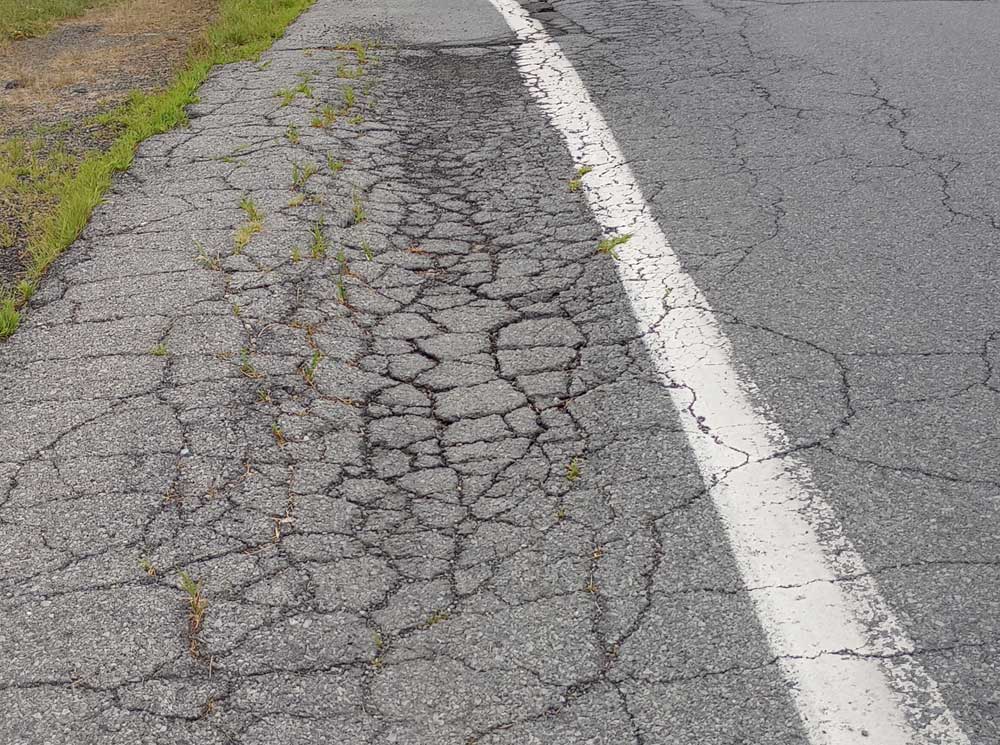
A small area of severe distress can feel like it should dominate the score, but PCI considers both severity and extent.
Two Ways to Handle It
Preferred approach:
- Segment the distressed area separately
If segmentation isn’t practical:
- Ask:
- How much of the road is affected?
- Does it impact most users?
A localized patch of alligator cracking does not equal total roadway failure. However, widespread moderate cracking absolutely should lower your score.
Focus on Dominant Distress, Not Every Imperfection
Another common mistake is trying to account for every minor defect equally.
Instead, prioritize:
- The primary distress type (cracking, rutting, potholes, etc.)
- The severity level (low, moderate, high)
- The extent of occurrence
Small, isolated issues should not drive the overall PCI score unless they are widespread or severe.
This simplifies field evaluations and leads to more consistent results.
A Practical “Field Scoring” Shortcut
While formal PCI surveys can be detailed, many municipal teams need a faster, practical method in the field.
A useful approach is to start at 100 and mentally subtract based on observed conditions.
Rule-of-Thumb Ranges
| Condition Description | Typical PCI Range |
|---|---|
| Like new pavement | 85–100 |
| Minor cracking, very little distress | 70–85 |
| Moderate cracking and patching | 55–70 |
| Significant fatigue cracking or rutting | 40–55 |
| Structural failure, widespread distress | Below 40 |
This is not a replacement for formal PCI calculations, but it provides a reliable, repeatable baseline for many real-world applications.
How to Handle Wetland or Chronic Failure Areas
The situation you described, where a small section near wetlands is failing, is extremely common.
These areas are typically driven by:
- Poor drainage
- Saturated subgrade soils
- Freeze-thaw cycles
- Loss of structural support
Importantly, this is often a localized structural issue, not representative of the entire road.
Best Practice:
- Score these sections as separate segments whenever possible
- Document them as chronic problem areas
If you cannot segment them, note the condition clearly so future evaluations remain consistent.
Consistency Matters More Than Precision
The most important takeaway is this:
PCI is most valuable when it is used consistently across your entire road network.
It is far better to:
- Apply the same logic everywhere
- Accept small imperfections in scoring
Than to:
- Spend excessive time trying to calculate a “perfect” number for each road
Over time, consistent scoring allows you to:
- Identify trends
- Prioritize maintenance
- Allocate budgets more effectively
If assigning a PCI score feels difficult, it’s usually not because you’re doing it wrong. It’s because you’re trying to make one number represent a complex, variable system.
Break the road into segments, focus on dominant conditions, and use weighted averages when necessary. Once you do that, PCI becomes what it was always intended to be: a practical tool for making better decisions about your roads.