





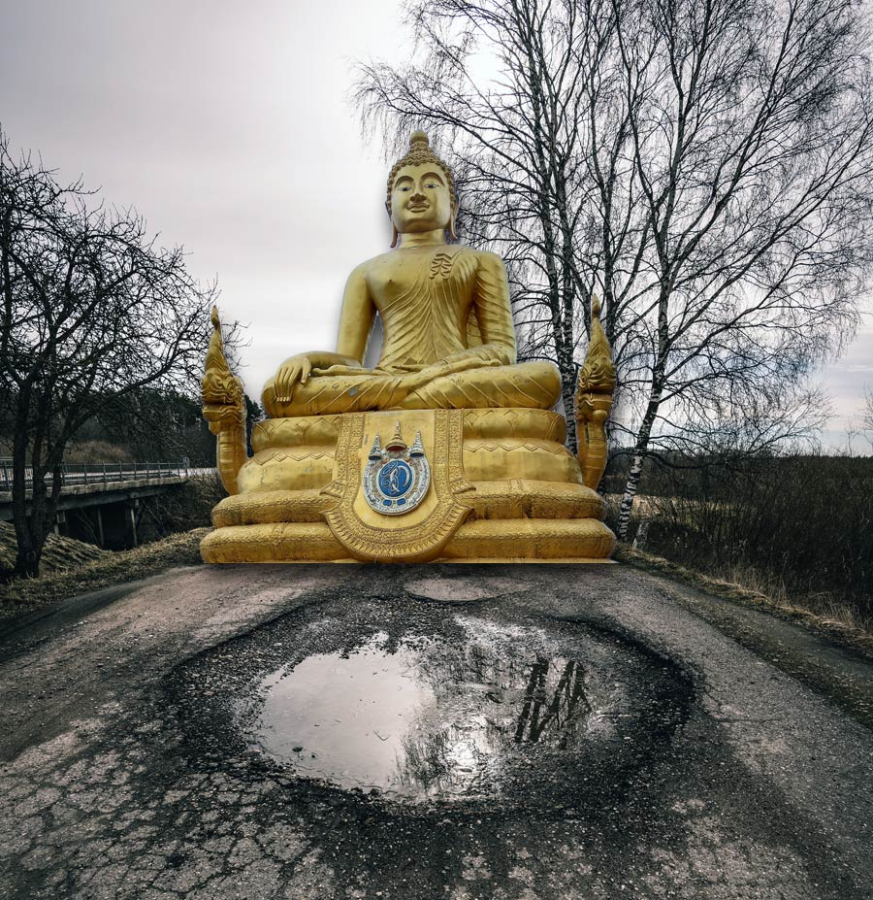
Listed in Road Maintenance
There is an old saying among highway workers: "The pothole you filled yesterday is the pothole that returns tomorrow." While this saying was almost certainly not uttered by Buddha beneath the Bodhi tree, one suspects he would have understood it immediately. After all, few things illustrate the nature of existence quite like pothole repair.
The First Noble Truth: Roads Suffer
Buddha taught that suffering is an unavoidable part of life. Highway superintendents might phrase it slightly differently:
"All pavement deteriorates."
The moment a road is paved, the forces of the universe begin conspiring against it. Sunlight attacks the binder. Water infiltrates microscopic cracks. Heavy trucks flex the pavement structure. Winter arrives with its armies of freeze-thaw cycles. Eventually, somewhere on an otherwise perfect roadway, a tiny crack forms. And thus, suffering begins.
The Second Noble Truth: The Cause of Suffering is Attachment
Buddha taught that suffering comes from attachment and the desire for permanence. Municipal officials often become attached to the idea that a pothole repair completed in February will still be there in April. This attachment leads only to disappointment.
The superintendent drives by the repair one morning after a spring rain and discovers that the patch has departed this world and entered another state of being, usually somewhere in the ditch. The wise highway professional understands: The cold patch was never truly ours. We merely borrowed it for a while.
The Third Noble Truth: Suffering Can End
Buddha believed there was a path to ending suffering. For potholes, this path is reconstruction. Unfortunately, reconstruction costs $2 million per mile and requires environmental reviews, engineering studies, public hearings, utility coordination, and approximately seventeen years of paperwork. Until enlightenment arrives in the form of funding, patching remains the practical path.
The Fourth Noble Truth: Follow the Eightfold Patch
Perhaps Buddha's famous Eightfold Path might be adapted for highway departments:
Right Observation
Inspect roads often and find problems while they are still cracks rather than craters capable of swallowing compact cars.
Right Materials
Cold patch has its place. Hot mix is preferable. Actual road base underneath is even better.
Right Timing
Repairing potholes during a snowstorm may build character, but it rarely builds longevity.
Right Compaction
A pothole filled without compaction merely becomes a slightly smaller pothole.
Right Drainage
Water is patient. Water always wins.
Right Equipment
The loader, roller, shovel, rake, lute, and asphalt hot box all have their role in the cosmic order.
Right Documentation
If it isn't documented, someone will eventually ask why the town never fixed that pothole that was definitely repaired three times already.
Right Expectations
No patch is forever. Some merely have longer and more meaningful lives than others.
Impermanence and Asphalt
One of Buddhism's central teachings is impermanence. Everything changes. Everything ages. Everything eventually breaks down. This may be philosophy to some people. To highway departments, it is simply pavement management. The road that was smooth in 2015 becomes rough in 2020. The road that needed crack sealing in 2020 needs overlays in 2025. The overlay installed in 2025 becomes tomorrow's capital project. The wheel continues turning.
The Zen of the Pothole Complaint
A resident calls to report a pothole. The highway crew repairs it. Another resident calls to report a different pothole. The crew repairs that one as well. Spring arrives and twenty more appear. The cycle continues.
The inexperienced superintendent asks:
"When will we finally be done with potholes?"
The experienced superintendent smiles peacefully and replies:
"We won't."
Oddly enough, there is comfort in that realization. There will always be another pothole. There will always be another snowstorm. There will always be another culvert, another sign replacement, another mailbox discussion, and another emergency call at 2:00 AM. The work is never finished because communities themselves are never finished.
Achieving Highway Enlightenment
Perhaps true highway enlightenment is not the elimination of potholes. Perhaps it is accepting their inevitable return while continuing to repair them anyway. To patch the pothole knowing another will appear. To pave the road knowing time will reclaim it. To serve the public despite understanding that next spring will bring another crop of frost heaves and complaints. There is dignity in that work. And if Buddha had ever spent a March morning riding in a one-ton dump truck with a load of cold patch and a coffee that went cold an hour ago, he might have simply nodded and said:
"Yes. This, too, is the way."